



|
 |
Without courage, there is no power on earth to deter an aggressor, nothing to oppose the principle that might is right. — John Percival Mike Morra's Roosevelt Island tram rescue From the book, Brave Hearts
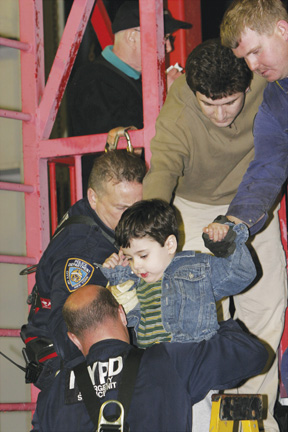
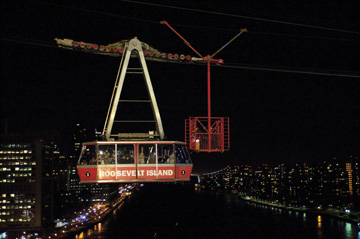
It was a little after five o’clock in the afternoon on that April day. A power failure had knocked out the tramway going between Manhattan and Roosevelt Island. Two tramcars holding a total of sixty-nine passengers, including two infants, several children, and a disabled woman, were trapped on the tramcars. One car was dangling two hundred and fifty feet above the cold East River. The other cable car stopped over the congested streets of New York. It looked like a scene right out of a big-budget disaster movie. In New York City, dangerous rescue operations like this are assigned to the Emergency Service Unit, a highly trained, close-knit division of four hundred officers working out of ten different squads called Trucks throughout the five boroughs of New York. Of the twenty-three New York City police officers who died saving people from the collapsing World Trade Center buildings on September 11, fourteen were from the Emergency Service Unit. The day the trams broke down, Mike Morra had been a police officer in New York City since 1995, but he was a newcomer to Emergency Service. He had wanted the assignment to ESU from the time he began hearing the stories about cops rappelling off the Brooklyn Bridge to save a jumper or breaching a door in the Bronx to arrest a heavily armed bad guy. There is a saying about the Unit. “When a citizen is in trouble, the person calls 911. When a cop is in trouble, they call ESU.” When the trams malfunctioned that April evening in 2006, it had only been six months since Mike finished Special Tactics School, a rigorous seven-month training program for all incoming ESU cops. The program covers everything from heavy weapons training to tips on how to deal with emotionally disturbed people who have gone off their meds. But he had been a cop for eleven years, and he had worked in Queens. He knew exactly where he and his partner needed to go to rescue the people in the disabled tram. Many agencies responded to the tram disaster. Over one hundred police officers, scores of firefighters, the NYPD’s Harbor and Aviation Units, the Police Commissioner, and even the Mayor showed up to help. However, ultimately, the rescue of the panicked people stranded in the tram would fall to Mike and Mike Iliadis, Ray Flood, and Dave Fiol, three of his colleagues from Emergency Service. With almost seventy lives in jeopardy, scores of officers rushed to the scene. When an incident occurs with the potential for great loss of life, officers can usually tell by the dispatcher’s tone. “You knew right away this was bad,” Mike said. “She kept saying it over and over. ‘Seventy people, seventy people, seventy people.’ You could hear it in her voice. She was nervous.” A quick inspection revealed the diesel generator that powered the tramline had blown, preventing the haul rope from moving the two cars along the track. The backup diesel had stalled, the brake would not release, and the tram operator’s radio was out. The officers discovered that the rescue cage had never been assembled by the tram company. It was still laying in pieces on the ground. That compounded the problem considerably. The cops knew they could get the people stranded in the tram above the street down without much trouble; they could use a crane. But the tram stranded above the East River was going to be a more difficult challenge. With police boats circling in the river below, the four ESU officers began assembling the rescue cage. Three hours later, the last bolt was screwed in. The men were drenched in sweat as they loaded in hundreds of feet of rope, harnesses, safety nets, baby food, diapers, bottles, and baggies. All these things would be needed since the passengers had been trapped for so many hours. Once the officers torque-wrenched the cage up onto the cables and hooked themselves in with the harnesses, they were ready to roll. Mike admits to having a few nervous moments when the tram’s mechanic admitted he was unsure how the cage would get by the first tower. It was hundreds feet to the second tower, but the three officers with Mike were among the most experienced in the Emergency Service Unit. He knew if anybody could get those people back down on the ground, they would be the ones to do it. Contrary to popular myth, not all cops have the guts to run toward screams and gunfire, but if there was a test for bravery, a way to determine who will risk their lives for others, there’s no doubt Morra, Iliadis, Flood, and Fiol would all score high. “There’s no one who’s worked with Mike Iliadis who doesn’t come away impressed,” Morra said. “Nothing gets to him. Under pressure he stays real calm. Same with Dave Fiol and Ray Flood. When this incident occurred, Ray had been in ESU for six years. He’s a rock when things get intense. Dave’s a former Marine and extremely disciplined.” Mike explains that for cops to perform where there is a good chance of injury or even death, it’s essential to have confidence in yourself and your equipment, but mostly you have to trust your partners. “You have to know your team will perform,” he said. As the steel cage moved out over the dark river, the terrified passengers were able to make eye contact with their saviors. For Emergency Service officers, dangling hundreds of feet above the icy East River is something they train to do. It’s a little scarier for civilians suspended over the water two hundred and fifty feet up in the air. As they got near the tram, the officers pulled the cage up as close as they could. The two Mikes put on their harnesses and hooked themselves to the cage. If they fell, they would still be attached. Morra leaned out and tried to pull the emergency cage closer, but there was still two-and-a-half feet between them, and the tram was a full foot-and-a-half lower than the cage. “I could barely reach it,” Mike remembered. “Mike Iliadis was holding on to me. Finally I was able to grab it.” The two officers hoisted themselves over to the tram. Their first task was to create a safety net between the tram and the rescue cage. If someone slipped, the net would prevent them from plunging into the river below. Ray and Dave passed strips of webbed netting to the two Mikes. It was painstaking work that took close to an hour. Once they were convinced the net would do its job, they were ready to start moving people out of the tram. Mike Morra instructed the passengers to get up one at a time and crawl out the window into the gap where Mike and Mike were waiting for them. As they came through the window, Morra and Iliadis grabbed each person as best they could and pushed them out and over to Ray and Dave, who were waiting for them inside the rescue cage on the other side of the net. One by one, the frightened, hungry, thirsty passengers made it over. Then it was a young father’s turn. He had a small baby clenched tight in his arms. The officers told him to hand them the baby. Once he was safely inside the rescue cage, they would hand him his child. At the time Mike Morra had two young daughters, and he knew what was going through the young dad’s mind. “Can you imagine being stranded that far up over the East River?” he asked. “It’s pitch dark and you have to hand your baby up to a person you don’t know and can barely see? I’m not sure I could have done it.” Morra summoned up all his negotiating skills, but things were not going well with the man and his child. At some point he had to face the fact the man was not going to let go of his child. He changed tactics. He stopped negotiating and began issuing orders. “I told him, ‘My name is Michael. I’m trained to do these rescues. You have to hand your baby to me. We have everything under control. We’ve done this before. You have no choice. Give me your baby.’” The entire operation took twelve hours. The cops were drained from the physical strain of the grueling work, but they were proud, too. Every one of the sixty-nine people was safely back on the ground. None of them had been injured. |
|
|---|